Grow Tomatoes, Not Data Centers

PERCEPTION ENABLED TECHNOLOGY
Click here to edit this paragraph and add your own content. This is a great place to expand on the title and any relevant details or information.
THE AUTONO CAR
Using groundbreaking perception-enabled sensor technology, the Autono car is a fully driverless vehicle engineered to the highest degree of precision and safety. It’s autonomous driving reimagined.

HUMAN-CENTERED DESIGN
I'm a paragraph. Click here to add your own text and edit me. It’s easy. Just click “Edit Text” or double click me to add your own content and make changes to the font. I’m a great place for you to tell a story and let your users know a little more about you.
LOW EMISSIONS & EFFICIENCY
I'm a paragraph. Click here to add your own text and edit me. It’s easy. Just click “Edit Text” or double click me to add your own content and make changes to the font. I’m a great place for you to tell a story and let your users know a little more about you.
THE AUTONO DIGITAL PRODUCTS
We’ve developed an app so that each vehicle can drive autonomously and make decisions based on real-time information and situational awareness.

ADVANCED CYBER SECURITY
I'm a paragraph. Click here to add your own text and edit me. It’s easy. Just click “Edit Text” or double click me to add your own content and make changes to the font. I’m a great place for you to tell a story and let your users know a little more about you.
REAL-TIME INFORMATION
I'm a paragraph. Click here to add your own text and edit me. It’s easy. Just click “Edit Text” or double click me to add your own content and make changes to the font. I’m a great place for you to tell a story and let your users know a little more about you.


Organizations & Processes Involved
The Hanover Planning Department analyzes how the proposal relates to applicable ordinances (e.g., rezoning from agricultural to limited industrial use) and long-range plans and summarizes public feedback. They schedule Public hearings before the Planning Commission and Board of Supervisors following applicant's community meeting. Per the Department (9/17/2025): "It is early in the review process, and there will be multiple opportunities for public feedback prior to a decision being made by the Board of Supervisors"
The Applicant (Developer) applicant schedules and conducts community meeting (Oct-Nov timeframe possible); in addition the applicant resubmits revised plans for an additional review.
Planning Commission meeting is held to review the case (earliest possible date is January 2026)
Board of Supervisors holds one or more public hearings; following public input the board determine final approval status.
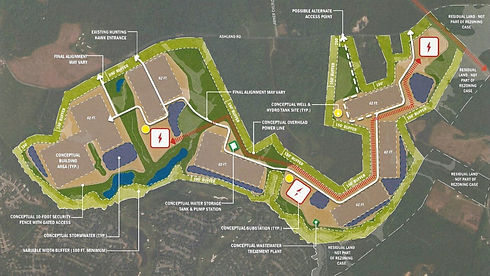
Residential Buffers
100-150 foot buffers from residential property lines, 200 feet from road frontage. (Industry average is 200-500 foot buffers and residents still complain of noise and vibration.)
All protections for residential property owners identified in the proffer statement refer to Hanover County with no mention of Henrico County.
Noise Attenuation
7AM-7PM Mon-Sat generator testing (one standard generartor operates at 85d. Multiply this by hundreds of generators to be tested. All protections for residential property owners identified in the proffer statement refer to Hanover County with no mention of Henrico County.
Noise attenuation to ensure conformation to Hanover noise ordinance. How would this apply in Henrico, where there is no noise ordinance?


Trading a water problem for a noise problem
At a community meeting on Nov. 17th, H.H. Hunt's team stated that they are abandoning the plan to use well water for cooling the data centers.
Instead, the new proposal is for a "closed loop water system". Under this plan, treated water would be "trucked into the site from elsewhere" to fill tanks and would then be used in a closed loop, meaning it is continually treated and recirculated within the site, not drawn from local wells.
Closed-loop chilled water systems rely on a massive external HVAC infrastructure. This equipment—which includes chillers, compressors, and large air-handling fans—runs 24/7 and is the main cause of the noise pollution associated with data centers.